
The Artificial Turf Installation Process: What Happens Between the Quote and the Finished Lawn
Deciding to replace your Los Angeles lawn with artificial turf is the easy part. Understanding what actually happens between the moment you approve the proposal and the day you walk out to a finished, lush artificial lawn — that is where many homeowners feel uncertain. What does the crew do first? How long does each phase take? When can you use the lawn? What does the process look like day by day?
This guide walks through the complete artificial turf installation process in Los Angeles from start to finish — step by step, in plain language — so there are no surprises and you know exactly what to expect from a quality installation.
Step 1: Site Assessment and Measurement
Before any proposal is written or any work begins, a professional artificial turf installer visits your property to assess the site conditions and take accurate measurements. This assessment covers the square footage of the area to be turfed, the existing ground condition and what will need to be removed, the drainage characteristics of the site, any grade issues that will require correction, and any access considerations that affect how equipment and materials will reach the work area.
Accurate measurement at this stage is the foundation of an accurate proposal. Any contractor who quotes a turf installation based on approximate dimensions described over the phone rather than a site visit is not giving you a reliable number.
Step 2: Existing Material Removal
The first physical step in any artificial turf installation is removing whatever is currently on the ground — natural grass, existing sod, old artificial turf, ground cover plants, or bare soil that has been prepared for installation.
Natural grass removal typically involves a sod cutter — a machine that strips the grass and the top layer of soil to a consistent depth. This removes the grass root system along with the sod itself, creating a clean base for the installation to follow.
Debris from the removed material is loaded and hauled away. A professional installation leaves the site clean after this phase rather than leaving cut sod piled on the property.
Step 3: Grading and Drainage Preparation
With the existing material removed, the site is graded — adjusted to ensure proper slope for drainage and a level surface that will produce a smooth, flat finished turf surface. This grading step is one of the most important in the entire installation process.
Proper grading for artificial turf installation in Los Angeles requires a slope of approximately one to two percent — roughly one inch of fall per eight feet of horizontal run — directed away from the home and toward the yard perimeter or designated drainage points. This slope ensures that water drains off the turf surface quickly and does not pool in low areas.
Any areas of the site with soft soil, fill material, or unstable ground conditions are addressed at this stage — compacted or amended to provide a stable, consistent base for the installation.
In areas where the existing drainage is inadequate — clay-heavy soils that do not absorb water efficiently, low-lying areas prone to pooling — additional drainage infrastructure may be installed at this stage. Perforated drain pipe or French drain systems direct excess water away from the turf area to prevent saturation of the base material.
Step 4: Weed Barrier Installation
A geotextile weed barrier fabric is installed over the prepared and graded soil surface before the base material is added. This fabric serves two purposes: it prevents weed growth from pushing up through the base and the turf above it, and it allows water to drain through while maintaining the separation between the soil and the base rock layer.
Quality weed barrier fabric is essential for a long-lasting artificial turf installation in Los Angeles. Cheap or inadequate barrier allows weed intrusion that is visible through the finished turf and requires significant effort to address after the installation is complete.
Step 5: Base Material Installation and Compaction
The aggregate base layer is the structural foundation of any artificial turf installation — the material layer beneath the turf that provides stability, drainage, and the firm, even surface that determines how the finished turf looks and feels underfoot.
The most commonly used base material for Los Angeles artificial turf installations is class II road base or decomposed granite — a well-graded aggregate that compacts to a dense, stable layer while maintaining adequate drainage. A typical artificial turf base in Los Angeles uses three to four inches of compacted aggregate base, though the appropriate depth depends on the soil conditions, drainage requirements, and intended use of the installation.
The base material is spread, leveled, and mechanically compacted in layers to achieve the density required for a firm, stable surface. This compaction step is critical — a base that is not adequately compacted will develop soft spots, uneven areas, and surface irregularities after the turf is installed and traffic is applied.
A final grading pass brings the compacted base to the precise finished grade and cross-slope needed for the drainage and surface level requirements of the installation.
Step 6: Turf Cutting and Layout
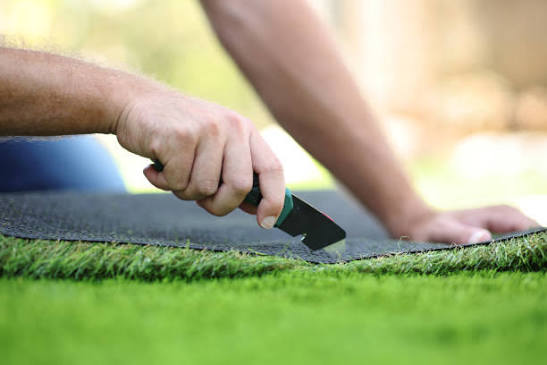
With the base prepared, the artificial turf product is rolled out, oriented, and cut to fit the precise dimensions of the installation area. This phase requires careful planning and skilled cutting to minimize waste, ensure that all turf sections face the same direction (critical for a natural, consistent appearance), and create clean, straight edges along borders.
For installations that require multiple turf pieces — most yards are too large to cover with a single roll — the seam locations are planned during this phase. Seam placement in areas of lower foot traffic and away from the primary sight lines of the installation minimizes the visual impact of joins.
Step 7: Seaming
Where multiple turf pieces are joined, the seam must be executed with precision to be invisible in the finished installation. Professional seaming involves cutting the turf edges to a precise alignment, applying seaming tape and adhesive beneath the join, and carefully pressing the edges together to create a continuous fiber surface without gaps or overlaps.
Seaming is one of the most skill-dependent steps in the entire artificial turf installation process. A poorly executed seam is visible and permanent — it remains as a line across the lawn for the life of the installation. Experienced installers take the time to execute seams correctly, matching fiber direction and density at the join.
Step 8: Perimeter Securing and Edge Treatment
The perimeter edges of the turf installation are secured to prevent lifting, shifting, or curling over time. In Los Angeles residential installations, this typically involves nailing or stapling the turf perimeter into bender board or a timber edge restraint installed at the perimeter, or using landscape staples driven through the turf backing into the compacted base at close intervals around the full perimeter.
The edge treatment — the visible border between the artificial turf surface and adjacent concrete, planting, or other materials — is one of the most important finish details of any installation. Clean, crisp edges at all transitions create the polished appearance that distinguishes a professional installation from an amateur one.
Step 9: Infill Application
Infill material is distributed across the surface of the installed turf and worked into the fiber using a power brush or power broom. The infill performs several important functions: it adds weight to the installation to prevent movement, it holds the turf fibers in their upright position, it provides cushioning beneath the fiber pile, and it contributes to the drainage performance of the system.
The most common infill materials used in Los Angeles residential artificial turf installations include silica sand, crumb rubber, or a blend of both. Sand provides a clean, neutral infill. Crumb rubber adds additional cushioning and is preferred for sports or play applications. For pet-specific installations, antimicrobial infill products that inhibit odor-causing bacteria are available and recommended.
Infill is applied in passes across the surface at the specified rate and worked into the fibers until the distribution is even throughout the installation.
Step 10: Final Brushing and Inspection
The finished installation is power-brushed across the surface to lift the turf fibers into their natural upright position, distribute the infill evenly, and create the natural, lush appearance of the completed lawn. This final brushing step is transformative — a turf surface that looks flat after infill application looks dramatically more natural and appealing after thorough power brushing.
A final inspection of the entire installation confirms that seams are invisible, edges are clean and secured, the surface is level with proper drainage slope, and the infill distribution is consistent throughout. Any items requiring touch-up are addressed before the crew leaves the site.
The client walkthrough confirms that the installation meets the agreed specifications and the client's expectations.
How Long Does Artificial Turf Installation Take in Los Angeles?
For a standard residential installation of 500 to 800 square feet in Los Angeles, the complete process from removal through final brushing typically takes two to three days. Larger installations or those requiring significant drainage work or grading corrections may take three to five days. The finished turf can be lightly used within 24 hours of completion and is fully ready for normal daily use within two to three days.
Stonewood Landscape: Expert Artificial Turf Installation Across Los Angeles
Stonewood Landscape installs premium artificial turf for homeowners throughout Los Angeles, including Culver City, Santa Monica, Beverly Hills, Encino, and Pacific Palisades. As a family-owned landscape design and construction company with over 10 years of experience and more than 500 completed projects, Stonewood executes every artificial turf installation with the precision, quality base preparation, and professional finishing that produces results homeowners are proud of for the full life of the installation.

A great artificial turf installation in Los Angeles is the result of a great process. Stonewood Landscape follows every step correctly, every time.
Visit stonewoodlandscapeinc.com to request your free estimate and start your Los Angeles artificial turf installation today.


